


The short answer
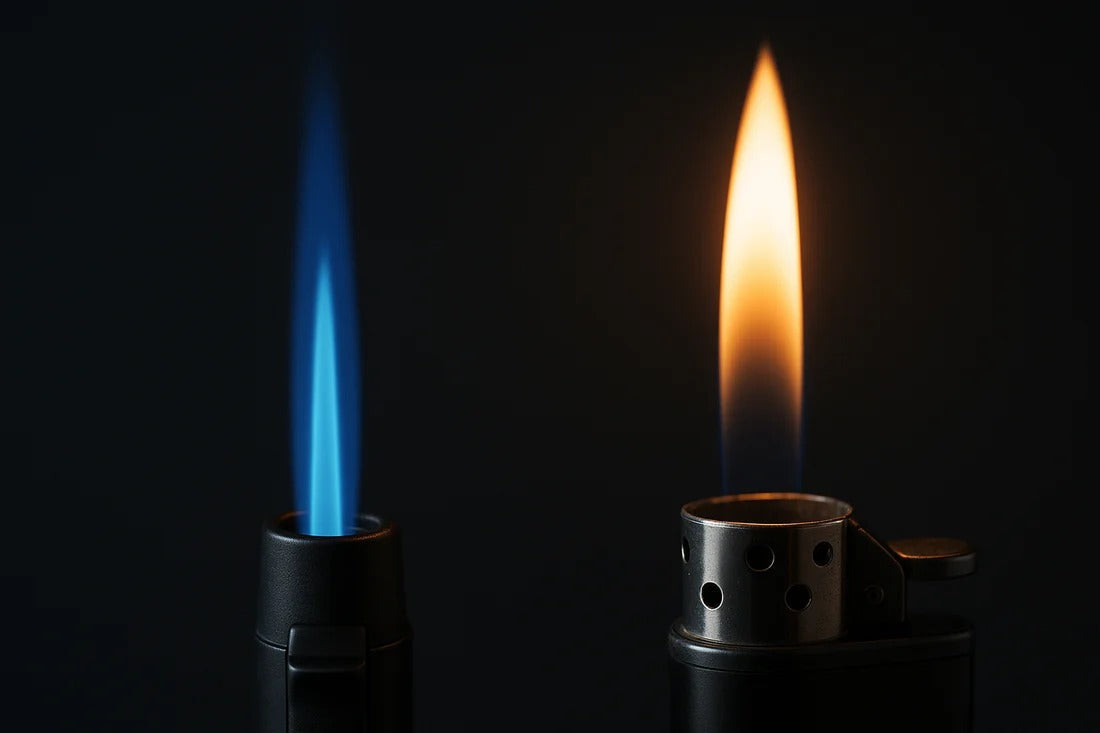
The difference between a jet flame and an ordinary flame lies in the mixing. With a jet flame, the gas is forced under pressure through a small hole and mixed with air along the way. The result is a short blue flame of around 1300 degrees that points straight ahead and doesn't move with the wind.
An ordinary flame, also called a soft flame, burns on the outside and reaches roughly 800 to 1000 degrees. That flame is yellow, soft and flickering, and simply blows out in a bit of wind.
For outdoors, fireworks, the barbecue and the fireplace, you want a jet flame lighter. For a cigar or a pipe, a soft flame is actually better.
Why a jet flame is blue
The colour says something about the combustion. Blue means the gas burns completely: enough oxygen has been mixed in before the fire catches.
Yellow means incomplete combustion. What you see as yellow light is glowing soot particles that haven't fully burnt. That's also why an ordinary flame leaves soot behind and a jet flame doesn't.
That complete combustion is what produces the heat. All the energy is released in a small volume instead of spread across a large, flickering flame.
And it explains the sound. A jet flame hisses because the gas passes through a narrow opening at speed. That's normal, not a fault.
When to choose which one
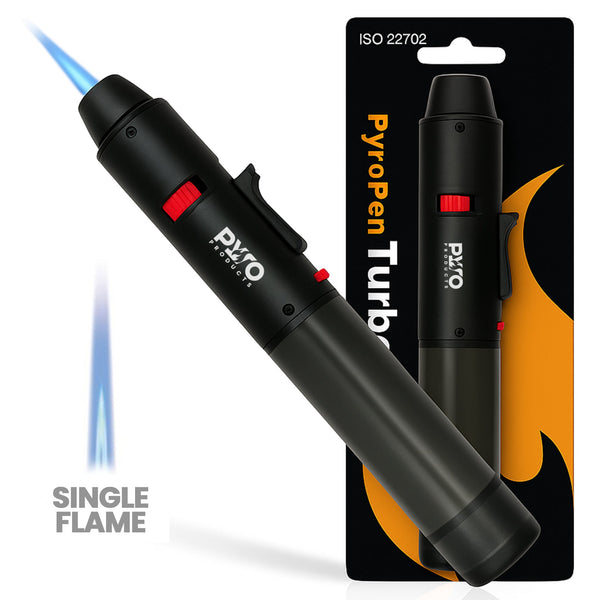
Outdoors the jet flame wins almost every time. The PyroPen Turbo is the simplest choice: a long body, so you keep your hand away from the fire, and the flame height is adjustable.
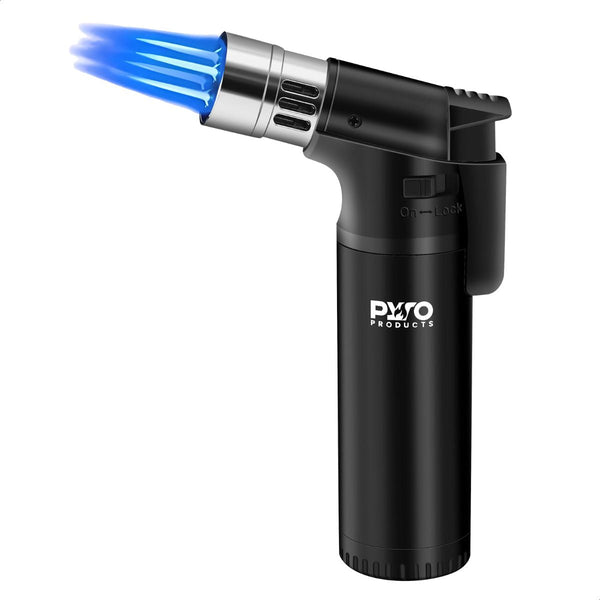
If you want more flame at once, the PyroTorch Quattro has four side by side. That makes the flame wider rather than hotter, which helps with a thick fuse or a firelighter cube.
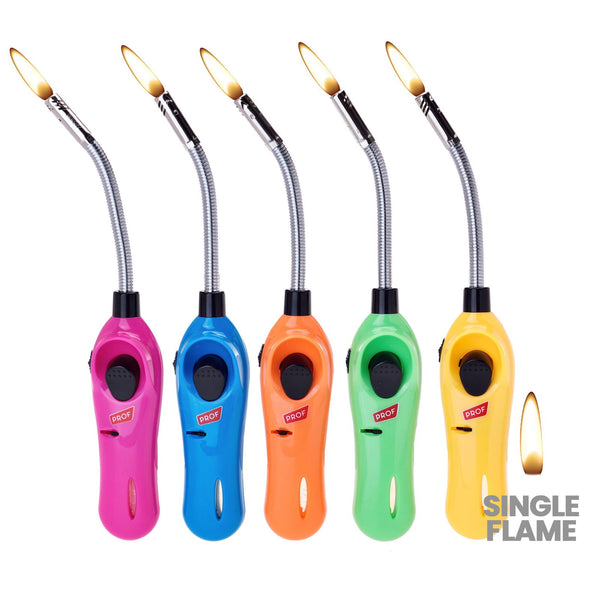
Indoors an ordinary flame is often nicer, because it is gentler and uses less gas. The 5x Prof Sealion Flex has a bendable neck that reaches into deep candle jars and lanterns without putting your hand inside.
If you simply want a few for candles and tealights, the 4x Prof Hake Lighter + Gas pack is the best value: four long lighters with gas included.
If you smoke a pipe, a soft flame remains the right choice, because a jet flame scorches the tobacco. The MYON Softflame Carbon was built for that, with three pipe tools. For a cigar a jet flame works fine, as long as you keep it half a centimetre away and keep turning the cigar.
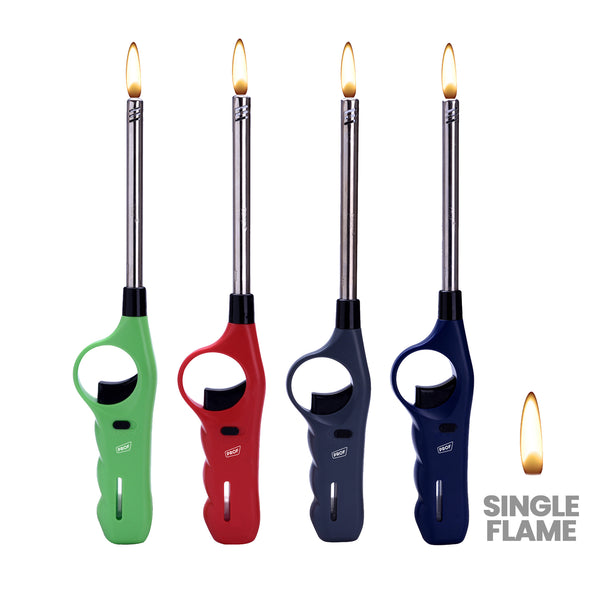
The two side by side
jetflame around 1300 °C · softflame 800 to 1000 °C
jetflame blue and complete · softflame yellow, with soot particles
jetflame stays lit even in strong wind · softflame goes out at wind force 3
jetflame uses gas noticeably faster · softflame lasts longer on one fill
jet flame: fireworks, barbecue, fireplace, outdoors · soft flame: candles, indoors, pipe
How much gas a jetflame uses
Here's the downside. A jetflame pushes gas out under pressure and therefore uses it up faster than a softflame. With a four-flame model, that happens four times as fast.
In practice you'll notice this mainly with prolonged use, for example when lighting a barbecue. For just a few seconds at a time it barely matters.
Refill with butane of at least 45 PSI. Cheap gas leaves residue in the narrow jet opening, causing the flame to lean or go out completely. The right stuff is in our lighter gas range.
If it does go wrong, it's almost always the gas, not the lighter. Find out what to do in lighter not working.
How to tell if a jetflame is properly adjusted
A healthy jetflame is short, blue and points straight forward. If you see a yellow tip at the end, too much gas is coming out for the amount of air mixed in.
In that case, turn the flame down slightly with the wheel on the bottom. A shorter blue flame is hotter than a long yellow one, even though the latter looks more impressive.
If the flame leans or sputters irregularly, there's dirt in the opening. This is almost always caused by cheap, unfiltered gas.
And always let it rest for two minutes after refilling. Fresh gas is cold, and as long as the tank hasn't reached room temperature, the flame will burn unevenly or not at all.
Torch, jetflame or storm lighter: the same thing
The names overlap and that's confusing. Torch, torch lighter, jetflame and turbo lighter all refer to the same principle: pressurised gas, blue flame.
Storm lighter is a common name, not a technology. It's usually a jetflame, since that's what withstands wind, but the term is also used for lighters with a windshield around them.
So don't go by the name, go by the flame. Blue and hissing is a jetflame; yellow and flickering is a softflame. More models can be found under storm lighters.
Frequently asked questions
With a jetflame, pressurised gas is mixed with air, giving a short blue flame of around 1300 degrees that doesn't flicker in the wind. A regular flame burns on the outside, is yellow, reaches 800 to 1000 degrees and moves with the wind.
Around 1300 degrees Celsius. A regular yellow flame tops out between 800 and 1000 degrees. This difference occurs because the gas in a jetflame burns completely rather than partially.
Because the gas escapes at speed through a narrow opening. That sound is normal and doesn't mean anything is broken. If it hisses irregularly or the flame leans, there's dirt in the jet opening.
Yes, as long as you keep your distance. A jet flame burns at around 1300 degrees, so held against the tobacco it chars the rim before the rest starts to glow. Hold the foot half a centimetre above the flame and keep turning the cigar. Outdoors a jet flame is actually the practical one, because a soft flame simply blows out.
Yes, noticeably. The gas escapes under pressure, and with a four-flame model this adds up quickly. For brief use it barely matters; if you're lighting an entire barbecue with it, you'll notice.
Our conclusion
Outdoors there is little to choose: an ordinary flame blows out and then you stand there fiddling. A jet flame solves that, and the higher gas consumption is what you pay for it.
Indoors it works the other way round. For candles, tealights and a pipe a soft flame is not a compromise but the better choice: calmer, more economical and plenty for what you are lighting.
Related articles
 Lighters
Which lighter is easiest for older people or arthritis?
 Lighters
Lighter not working anymore? Find the cause
 Lighters
Can you take a lighter on a plane?
More articles like this?
New tips, product comparisons and exclusive offers straight to your inbox. Plus 10% off your first order.